
Learning to play songs on the ukulele can be both fun and rewarding, especially when using ukulele tabs. Tablature (or TAB) is a simple way to learn music that uses lines, numbers, and symbols. It might look confusing at first, but once you get the hang of it, you’ll be reading tabs as easily as a book.
This guide will walk you through the basics of reading ukulele tabs, along with examples to help you practice.
The short version
- The four lines are your four strings. The top line is your A string, the one closest to the floor. The bottom line is your G string, the one closest to your face.
- The numbers are frets. A 3 on the C string means press the C string at the 3rd fret and pluck it. A 0 means play the string open, without pressing anything.
- Read left to right, like a sentence.
- Numbers stacked on top of each other are played together. That is a chord.
- Tab tells you which notes and where. It does not tell you the rhythm, so you need to know roughly how the song goes.
- What is ukulele tab?
- The anatomy of ukulele tab
- Other important symbols
- Examples for you to try
- The problems with ukulele tab
What Is Ukulele Tab?
TAB stands for tablature, and fundamentally, it’s a very simplified way of reading sheet music. Instead of telling us what notes to play and forcing us to figure out where those notes are, TABs act as a visual fretboard and tell you not only what notes to play but also where they are on the ukulele fretboard.
It’s increasingly popular because we can look at TABs and play them without having to know anything about reading music, such as key signatures, scales, harmonics, and time signatures. As long as we have a rough idea of what we are trying to learn sounds like, you can begin to learn it rather quickly depending on skill level.
Free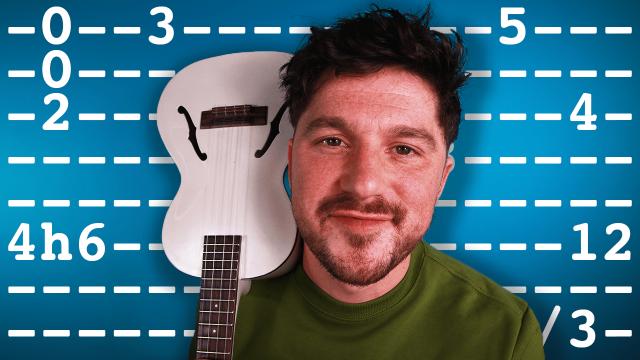
You can learn more about how to read ukulele tabs and loads of other topics in my Mastering Ukulele Tabs course
The Anatomy Of Ukulele Tab
The Strings
If you think of TAB as a ukulele fretboard, it’s going to make your understanding of it a lot easier. Imagine you are hovering above it and looking straight down. You have four horizontal lines that are made up of dashes, and they represent your strings. You can tell which strings they are because of the letter on the far left.
A |------------------------|------------------------|E |------------------------|------------------------|C |------------------------|------------------------|G |------------------------|------------------------|
The Frets And Notes
Next, you have the numbers, and these represent the frets. The numbers tell you which fret to put your finger on. So, if you see the number 3 on the C string, you need to press your finger down on the 3rd fret and pluck the string.
A |---5--4--------5--4-----|---3--2--------5--4-----|E |---------5-----------5--|---------3-----------5--|C |2-----------2-----------|0-----------2-----------|G |------------------------|------------------------|
Chords
When you see multiple numbers above or beneath each other, this represents a chord. For example, if you see 0 on the G, 2 on the C, 3 on the E, and 2 on the A, the tab is telling you to play a G Major chord. You can either pluck them all with four fingers or strum them, depending on what the song requires.
A |2--5--4-----2--5--4-----|3--3--2-----2--5--4-----|E |3--------5--3--------5--|0--------3--3--------5--|C |2-----------2-----------|0-----------2-----------|G |0-----------------------|0-----------0-----------|
New Sections
The lines that split the strings signal the start of a new bar or section of the song.
A |---5--4--------5--4-----|---3--2--------5--4-----|E |---------5-----------5--|---------3-----------5--|C |2-----------2-----------|0-----------2-----------|G |------------------------|------------------------|
Those are the basics of how to read ukulele tabs. However, as you advance as a player, you might stumble across some other interesting things on the tabs.
Other Important Symbols
The following techniques are used to add dynamics to our ukulele playing.
Hammer Ons
This is the “h” that sits between 2 numbers.
A |---------------0h2------|E |---------2h3------------|C |0h2---------------------|G |------------------------|
To execute a hammer-on, you need to pluck the first note as normal. Then use your next finger to press down on the following fret without plucking.
Pull Offs
This is the “p” that also sits between 2 numbers.
A |---------------3p2------|E |---------3p2------------|C |4p2---------------------|G |------------------------|
A pull-off is something like a backwards hammer-on. Instead of placing a new finger on, you remove one of your fretting fingers. In the example above, you would place your first finger on the 5th fret and your ring finger on the 7th. While holding both frets, pluck the string and then drag your ring finger off. This will reveal the note on the 5th fret. It’s important to drag the string as this will amplify the sound of the note.
Slide
This is the “/” or “” that instructs you to slide between notes.
A |---------------7\5------|E |---------5/7------------|C |4/7---------------------|G |------------------------|
Sliding creates a smooth transition between notes. It’s great for adding a touch of delicacy to your arrangements. To execute a slide, pluck the first note and then slide either up or down, depending on which way the slash is facing.
Vibrato
The “~” symbol requires us to vibrate the strings.
A |---------------4~----7~-|E |---------5~-------------|C |4~----------------------|G |------------------------|
Vibrato has its origins in blues music. It’s the motion of bending the string up and down very softly. Most of the movement should come from your wrist and hand.
Bend
This is the “b” that you will find between 2 numbers.
A |7b9---5b7---------------|E |---------------7b9------|C |------------------4b5---|G |------------------------|
Bending the strings has a similar sound to a slide. It’s essentially a smooth transition between notes, but instead of moving to a new fret, we bend the string to get a new pitch (the number following the “b” symbol). For a more in-depth guide on how to bend your ukulele strings, check out this one on liveukulele.com.
Examples For You To Try
Now that you have an understanding of how to read TABs, here are a few examples you can try to play.
Smashing Pumpkins – Today
Here’s an idea to make this easier to play: place your first finger across the 5th fret on both the A and E strings. Then use your ring finger for the 7th fret and your pinky finger for the pull-off on the 9th fret.
A |--5-----7-----5-----9p5-----|E |-----5-----5-----5-------5--|C |----------------------------|G |----------------------------|
Billie Eilish – Lovely
This is a great tab to try as it involves both chords and a riff to play. There’s also a hammer-on and pull-off too.
A |-2-------------------|-2------------------|E |-0---5-3-2-----5-3-2-|-3--5-3-2---2-----3-|C |-0---------4---------|-4--------4-----4---|G |-0-------------------|--------------------|A |-2-------------------|------------------------|E |-0---5-3-2-----5-3-2-|-----2h3p2--------2p0-3-|C |-0---------4---------|-4---------4---0--------|G |-0-------------------|------------------------|
Vampire Weekend – Cousins
Time to speed things up! The easiest way to play this is to utilize your first finger. Place it on the 4th fret of both the C and E strings. That way, you can move it straight onto the 6th fret for the next set of notes.
A |---------7----------7-7-7----------7----------6-|E |---4---6-6----4---6-6-6-6----4---6-6----4---6-7-|C |-4---6---6--4---6---6-6-6--4---6---6--4---6---6-|G |------------------------------------------------|
It’s worth noting that the majority of ukulele tabs you find online won’t be color-coded like the ones above.
Now that you know how to read tabs and hopefully are able to play a few songs, let’s talk about some common issues that arise with tab.
The Problems With Ukulele Tab
Not A Clear Picture
While tab is great for beginners who are just starting out or people who are familiar with the songs they are trying to play, there are a few issues when it comes to relying on TABs to learn songs.
After you have learned how to read ukulele tabs, one of the main issues is that there’s no sense of timing in TABs. Unlike sheet music, it’s impossible for the TAB to tell you how much space you should leave between notes or how quickly you should play notes after each other.
The only way to combat this is to know how the song sounds before you start learning it, which is the case about 99% of the time. However, if you are seeing the TAB for the first time, you will need to listen to the song to learn it. With sheet music, through the use of quavers and crotchets, you would be able to know exactly how long to play each note.
Lack Of Tabs Online
Another issue with TAB is the severe lack of it on the internet, especially for the ukulele. You can find guitar tabs for any song you want, but when it comes to finding them for the four-string ukulele, you’re going to become stuck very quickly.
The workaround is to take a guitar tab and adapt it for the ukulele, which is easier than it sounds once you know how the two line up.
Summary
I hope this guide has been useful and that tabs make a bit more sense now than they did twenty minutes ago.
Which brings us neatly back to the problem above. Ukulele tabs are hard to find, so I have spent years writing them and putting them on this site for nothing. There are hundreds of them, sorted by artist, decade, genre and difficulty, and you can now read every single one.